Smartphones · Apple
iPhone 18 Pro Max review: 30 days later, and it's still in my pocket
Verdict
The first iPhone in five or six years I haven't felt the urge to send back after a month. The cameras are why: a telephoto that finally focuses close, focus tracking that just works, and the low-light jitter gone. It is not my main phone yet, but it is staying in my pocket, and that is new.
Pros
- Pro controls in Apple's own camera app: shutter speed, white balance, long exposures you actually want to take
- The telephoto's minimum focus distance is finally sane, and focus tracking is an absolute godsend
- The low-light jitter on the 4x telephoto is fixed. I had to hunt to reproduce it
- ProRes Log is back to best in business, and the iPhone is back in my camera bag for video
- Runs about 10 degrees cooler than the 17 Pro Max under an hour of heavy gaming
Cons
- 5G that says 5G and doesn't behave like it, with Siri failing alongside it
- Battery optimisation should be proactive on a heavy day, not a setting you remember to turn on
- Heavier than the 17 Pro Max, and you feel it after an hour
I spend a lot of the year putting phones against each other. Samsung against Apple, Apple against Google, OPPO, Honor, Xiaomi. Today there’s only one phone, because the best way to review something is to really use it, the way you would.
So this is the month, not the week. And to make the month mean something, I spent one very busy day in Bath with it, leaving the house at 7am on 100% and filming what happened until bedtime. One rule, which you can hold me to: if the battery dropped under 50% at any point, the power bank went on, on camera.
No unboxing, no spec dump. Here’s what thirty days actually taught me.
The short version, if you’re in a hurry. This is the first iPhone in a long while that I haven’t wanted to send back after a month. The cameras are the headline, and I’ve now got three proper technical reasons for that rather than the feeling I had in week one. There’s a reception problem I need to talk about, and I’ll show you how to check your own phone for it. What I still haven’t decided is whether it takes over as my main phone.
Pro controls are the most fun I’ve had with an iPhone in years
This is the thing I’ve enjoyed most in the whole month. Shutter speed, white balance, proper manual control in Apple’s own camera app without downloading anything extra.
It isn’t complete. There are no ISO controls and you can’t pick precise values, so Apple is still deciding what you’re allowed to choose. But it’s enough to change what you go out and shoot.
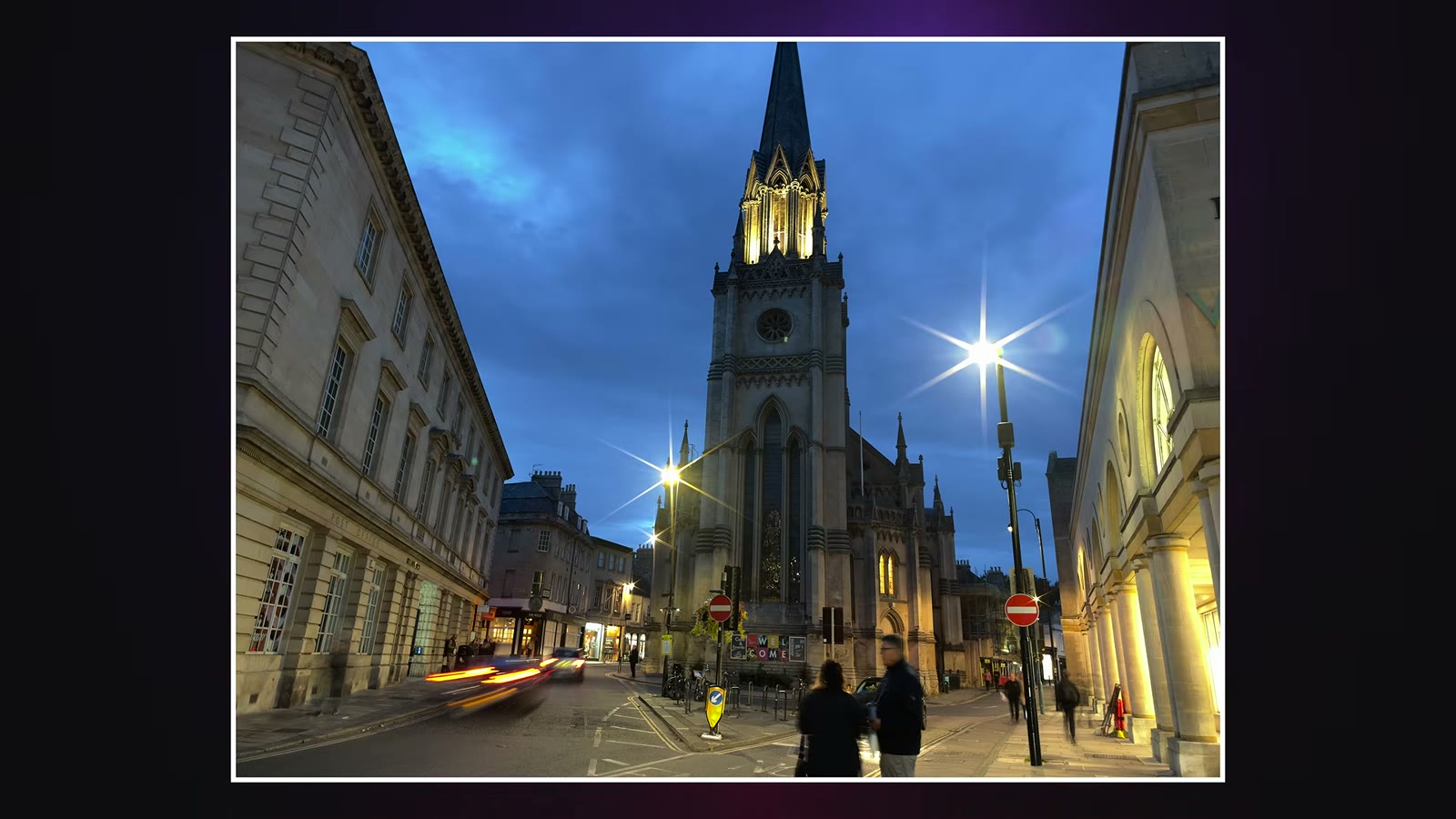
Long exposures are where it shows. People blurred into ghosts with the street staying sharp, water going silky, and my favourite, cars and buses turning into ribbons of light. You don’t need an ND filter for most of it either: wait for the half hour either side of sunset and you get the same result. In the middle of the day you will need one.
There’s also a starburst effect on lights this year, which is new. One thing worth knowing because it caught me out: it only seems to work on the main lens at 1x or 2x, where the variable aperture can stop right down. Try the same shot on the 4x telephoto and you don’t get it. If your long exposures aren’t producing starbursts, that’s probably why.
Here’s why this matters more than a spec. iPhones have been frankly boring for a long time, producing the same shot everyone else gets. This one makes you create something that’s yours. Some of your shots will be bad, depending on your experience. Experiment anyway.
Three technical reasons the cameras are better, not just a feeling
A month ago I sat here saying this could be the best iPhone camera I’d owned, and I was uneasy about how subjective that was. Now I can back it up.
The minimum focus distance on the telephoto. It was terrible on every iPhone until now. You can get genuinely close with the telephoto, and focusing is far more consistent. I like standing back and shooting on the long lens for the separation it gives, so this one changed how I shoot.
Focus tracking. Double tap a subject in photo or video and the focus stays there. That is huge. I said I wasn’t comparing today, but Android has had this for years, and having it now is an absolute godsend because it just works.
Low light on the 4x telephoto. There was serious jitter and a mess of a picture on that lens in dim light, and by dim I mean 5 or 6pm in a British autumn, not darkness. I’ve been able to reproduce it, but you have to really hunt for it. Whatever they did, they fixed it.
So is this the best camera on a phone in 2026? Probably not, and that’s another video. As far as iPhones go, it’s clearly a different animal.
ProRes Log, and the iPhone back in my camera bag
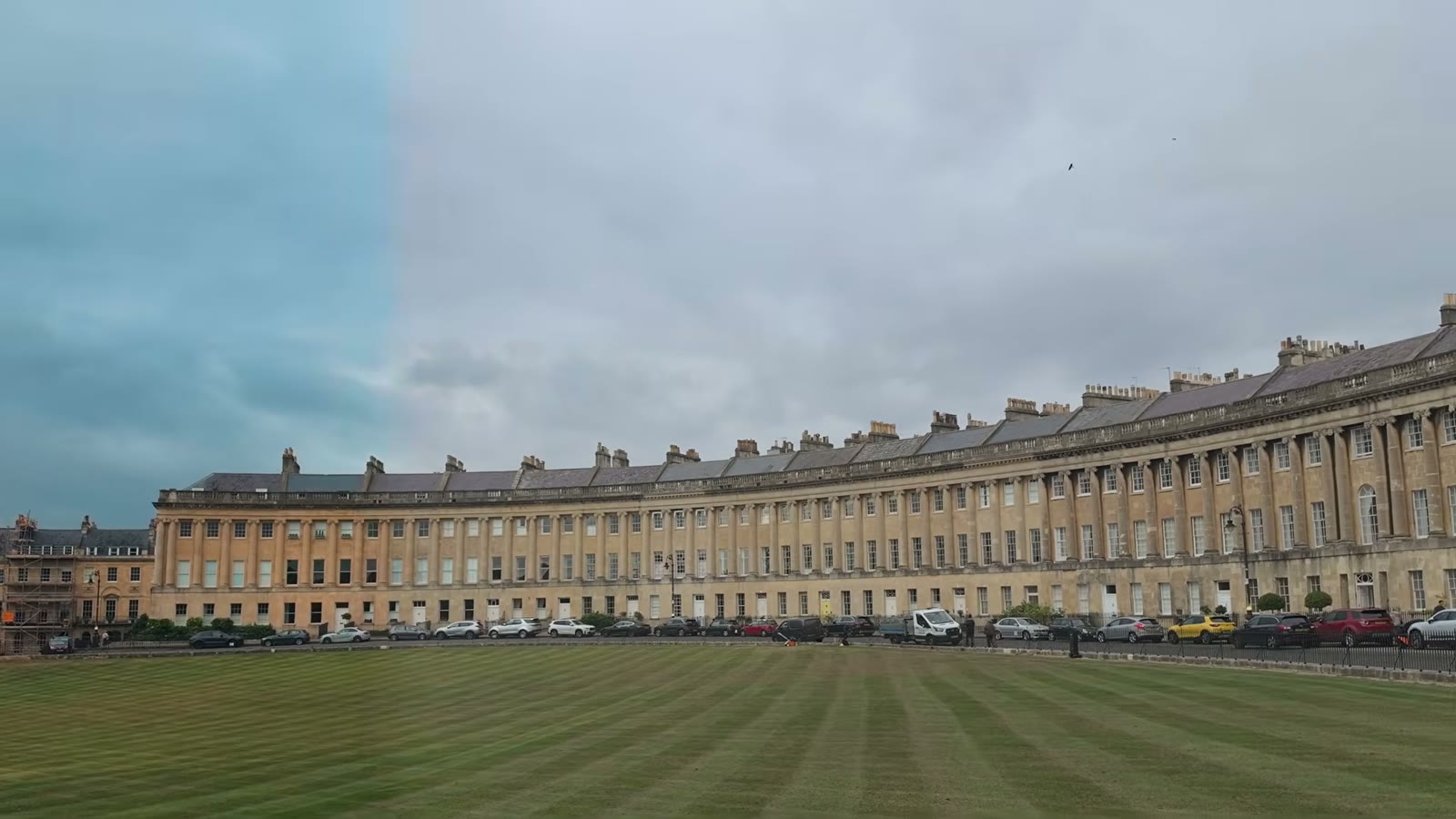
In week one I said this was getting me back to using an iPhone as my main video camera, and a month later I still mean it. If I’m carrying my proper camera I’ll use that, but most of the time I’m reaching for the iPhone for clips, because I can shoot ProRes Log and put my own colours on it.
It could be more convenient. Other phones let you load your own LUTs onto the device, and Apple doesn’t.
Most people don’t need any of this and I won’t pretend otherwise. But if you grade your own footage, if you want it to look like yours rather than everyone else’s, this is about as close to a proper camera as a phone gets. That’s why the iPhone is back in my camera bag as a video phone, not just in my pocket as a phone.
A full day’s battery, with nothing hidden
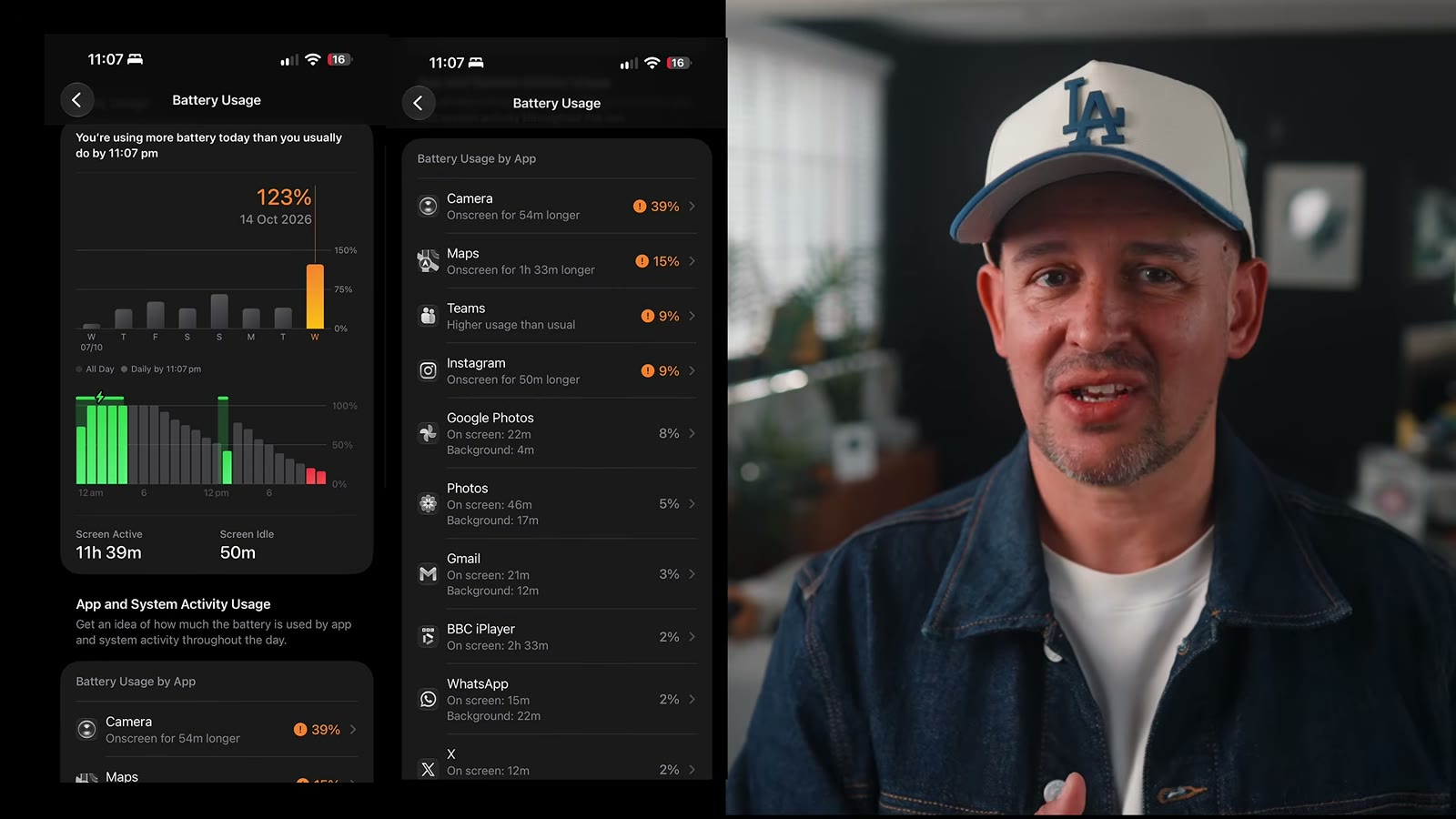
Here’s the day, honestly, because I hate saying a battery is better than last year’s without showing you.
| Time | Battery | What had happened |
|---|---|---|
| 7:00 | 100% | Left the house |
| 8:00 | 89% | 50 minutes of Maps, 10 minutes of camera |
| 9:00 | 84% | An hour of photos and video, email, Instagram |
| 12:30 | 56% | A busy morning of filming and posting |
| 14:00 | 41% | The rule kicks in, power bank on |
| 14:20 | 81% | Twenty minutes of charging |
| 17:30 | 52% | A 40 minute video call on Teams |
| 20:45 | 26% | Home, after another hour of Maps |
Screen on time was 11 hours 40 minutes, which is not a normal day for anyone. Full brightness all day in direct sun, with the phone’s own battery management turned off, because I told it to run until it dies.
Two things surprised me in that graph. Microsoft Teams ate battery out of all proportion to a 40 minute call, roughly on par with Instagram, so watch that if you take video calls on your phone. And the 2pm top-up is visible as a cliff.
The verdict: on a normal day this is about 10% better than the 17 Pro Max was for me. I come home with 10% more than I used to. On a day like the one in the video, with full brightness, outdoor shooting, posting and video calls, you’ll want a top-up somewhere. If you have a lot of those days, carry something to charge from. Not for the spec sheet, but because being stuck at 5% when you still need an Uber at the other end of a train journey is an anxiety that isn’t worth it.
What I’d still like fixed is the intelligence of it. With AI in everything, the phone should be telling me at lunchtime that I’m on course to run out by seven. It shouldn’t need me to remember a setting.
The 5G that says 5G and isn’t
This bugged me all month. The icon says 5G, sometimes 5G Plus. The experience, here in the UK, is not 5G: pages hanging, messages taking their time, and Siri doing the thing where I ask it something and nothing happens until I ask whether it’s online, at which point it cheerfully apologises.
I’m on O2 in the UK, so this could be my network, and I’ve got another phone on a different network with much better reception. That isn’t a fair test, so I’m not making that comparison here. I’ll get to the bottom of it properly.
What I can give you is a way to check your own, and it takes about 30 seconds. Open the phone app and dial *3001#12345#*. That opens the field test screen. Ignore nearly all of it and find RSRP, which is your signal strength:
| RSRP | What it means |
|---|---|
| Around -80 | Excellent |
| Around -90 | Good |
| Around -100 | You’ll notice it |
| -110 or worse | You’ll struggle, and that’s where I am |
That was mine in the middle of Bath. Not London, not Manchester, but a busy town. The phone wasn’t lying about the bars it had. The icon was promising an experience I wasn’t getting.
The display, the heat, and the things that just work
My panel is the LG one, and it’s cooler in tone than the 17 Pro Max. I’d flagged that in week one and one of you called it correctly. I’m glad Apple went this way. I used to hate that orangey cast.
It’s bright enough that I read on it in direct sun all day without thinking about it, although brightness stopped impressing me years ago. What I want next is eye care: proper PWM dimming and better anti-reflectiveness. It doesn’t affect me personally, but plenty of people get headaches from flicker they can’t consciously see, and other brands are well ahead here. Apple knows it.
Performance is fine and I tried to break it. An hour of a game that has cooked previous iPhones, highest settings, and the thermal camera stayed comfortable. The 17 Pro Max ran about 10 degrees hotter in the same test, which is a difference you feel in your hand.
iOS 27 is better without being great. I’d still love proper multi-window, and maybe that’s what the Duo is for. I did have to restart the phone once this month when it simply froze. Once in a month isn’t a disaster, and the 16 Pro Max’s first month was far worse, but on a top-end iPhone it shouldn’t happen at all.
Then there’s the thing I can’t argue with. Paying for things, tapping through barriers, airports in several countries this month. Double tap, look at it, done. It effectively never fails. It hurts me to say it, but I hate that I love it.
What Apple actually fixed, in my words
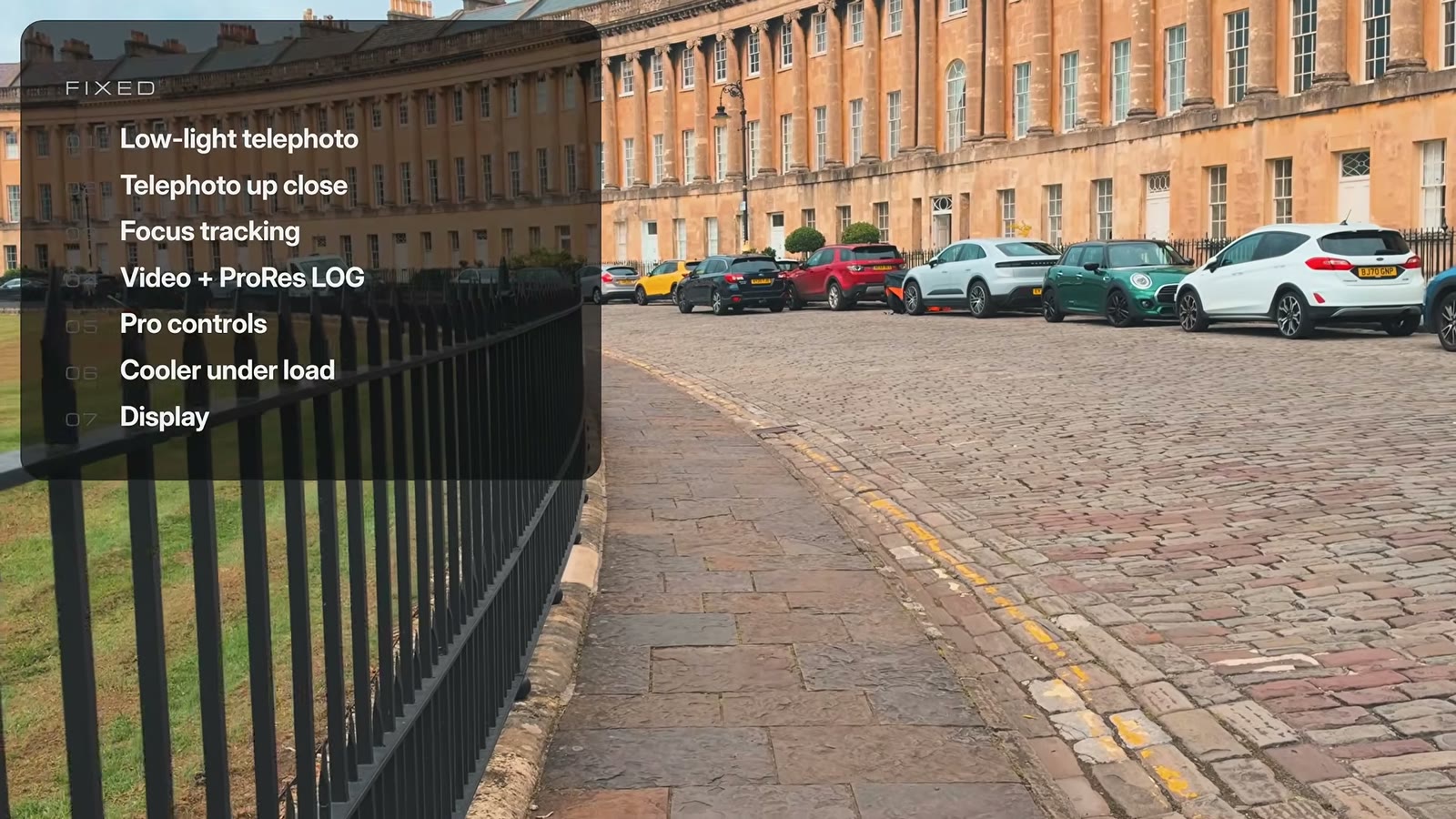
Not Apple’s marketing, and not the Apple-friendly channels. This is the month’s list:
- Low-light telephoto, photo and video. The most improved thing of the year.
- Telephoto close-up distance, finally.
- Focus tracking.
- ProRes Log, back to the best in the business.
- Pro controls and the long exposures they unlock.
- Running cooler under sustained load.
- The display’s colour tone.
And the things still on my list: battery intelligence on heavy days, the reception and Siri business, and the weight. It’s heavier than the 17 Pro Max and you feel it after an hour of anything. I take the point that heavier reads as more premium, the way it does with watches. I’d still like it lighter.
So where does that leave it?
The iPhone 18 Pro Max is a much better iPhone than its predecessors. In a way it’s what I expected the 17 Pro Max to be last year, and we didn’t get it.
Has it replaced my main phone? No, not yet. It would be great content to sit here and announce that a long-time Android user had switched, and if it ever happens I’ll tell you. It hasn’t happened in five or six years.
But here’s what I do know, and I think it counts for more than a verdict I’d have to manufacture. This is the first iPhone in about that long where, after a month, I don’t feel the urge to send it back, hand it to a family member or sell it on. It’s staying in my pocket for now, and maybe that’s the review.
If you’re coming from a 17 Pro Max specifically, that’s its own question, and I’ve answered it in the iPhone 18 Pro Max vs 17 Pro Max comparison. Everything here is about whether this phone is good, not whether last year’s was bad.
FAQ
Is the iPhone 18 Pro Max worth upgrading to? After a month with the iPhone 18 Pro Max, the upgrade case rests on the cameras: a usable telephoto minimum focus distance, focus tracking, fixed low-light telephoto, and manual Pro controls. If none of those describe how you shoot, the rest of the phone is an improvement rather than a reason to spend.
How is the iPhone 18 Pro Max battery life? On a normal day the iPhone 18 Pro Max lasts about 10% longer than the 17 Pro Max did for me. On a heavy day of full brightness, outdoor filming, navigation and video calls, it reached 41% by 2pm and needed a top-up to finish the day with 11 hours 40 of screen on time.
Does the iPhone 18 Pro Max have 5G problems? My iPhone 18 Pro Max reports 5G while delivering something closer to 4G, with slow pages and Siri failing to respond. My signal strength reads -110 RSRP or worse, which is in the struggling range. I’m on O2 in the UK, so I can’t yet separate the phone from the network.
Can you shoot ProRes Log on the iPhone 18 Pro Max? Yes, and it’s back to being the best in the business for phone video. You can shoot ProRes Log and grade it yourself afterwards. The limitation is that you can’t load your own LUTs onto the phone, which some Android phones allow.
Does the iPhone 18 Pro Max overheat? No. An hour of a demanding game at the highest settings kept the iPhone 18 Pro Max at a comfortable temperature on a thermal camera, running roughly 10 degrees cooler than the 17 Pro Max in the same test. The heat problem of previous generations appears to be solved.
Behind The Lens is my free newsletter, and it’s where this kind of month-long testing gets written up while it’s still happening: what the reception testing actually shows once I get two phones on the same network, which phone wins the camera shootout, and the occasional honest “don’t bother” before it reaches a video. Sign up here.
You can also find me on YouTube and Instagram if you’d rather watch than read.