Smartphones · Xiaomi
Xiaomi 17T Pro: I Took It to Asia as My Main Camera
Verdict
Ten days across Macau and Taipei with this as my only camera, and it kept up. The Leica Authentic mode gives photos actual character when everyone else's are turning samey, the 5x telephoto is the upgrade I care about, and on-device LUTs for LOG video are the most underrated feature on any phone right now. Thermals embarrassed flagships costing twice as much, and it ships with a 100W charger in the box. Long exposure still lags OPPO, and the speakers are ordinary.
Pros
- Leica Authentic mode: moody, characterful photos when rivals look pristine and samey
- On-device LUTs applied to LOG footage, with adjustable intensity after recording
- 8K30 and 4K120 at this price is genuinely unusual
- Thermals beat the iPhone 17 Pro Max, S26 Ultra and Find X9 Ultra on the same trip
- 7,000mAh means a full day and then some, with a 100W charger included
Cons
- Long exposure light trails come out dotted rather than continuous, where OPPO looks closer to a real camera
- Speakers are fine and no more
- Optical fingerprint reader, not ultrasonic
- Design is essentially last year's, if that matters to you
Rather than walk you through a spec sheet, I took the Xiaomi 17T Pro to Asia and used it as my main camera for the whole trip. Ten days: five in Macau for Beyond Expo, then Taipei for Computex, plus a load of shots back home in London. Here’s the full video.
Everything you’ll see was shot in Leica Authentic mode at 12.5 megapixels rather than 50, and where I used the full resolution I flagged it on screen. Consistency matters when you’re judging a camera.
How this one reached me, because you should know: Xiaomi sent the phone for review with no strings attached. They ran a press trip to Austria for creators and I didn’t go. They also offered to cover my travel to their London store opening, and I didn’t claim it, so that one was on me. The Asia trip was a completely separate engagement with its own video; I just took the 17T Pro along to test it properly. Nobody saw a word of this before you did.

The design, briefly
I like the deep violet. There’s a deep blue and a black as well, both nice, but the violet feels a little classier. Let’s be honest though: it looks very much like last year’s design. There’s a lot going on under the hood, which is where this gets interesting.
The camera, which is why you’re here
My favourite upgrade is the 5x telephoto. Shooting around Taipei with it was a genuine pleasure, and I appreciate the darker tones and the live vignette you get in the Leica mode.
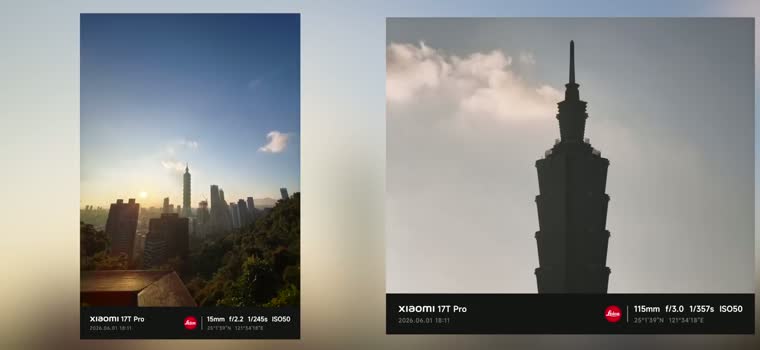
Here’s the thing I keep coming back to. Lately I’ve found photos from the iPhone, the Pixel, and to an extent the Galaxy, are great photos that are starting to look a bit samey. All very pristine, and without much character. Xiaomi’s Leica colour science gives you moody images with something to them, and it’s been that way since I reviewed the 15 Ultra.
What stood out across four countries was consistency. White balance is rock solid, and focus and exposure are predictable, which is exactly what you want when you’re shooting on the move rather than setting up.
The phone handled Macau’s heat and humidity, which meant a lot of artificial light because I was indoors or waiting for evening. At the UFC event it delivered properly in low light. Even the 10x, which isn’t optical, produced shots I was surprised by.
Where it falls short: the long exposure mode. Car light trails come out dotted rather than one continuous line, where OPPO’s Find X9 Ultra and X9 Pro get closer to what a real camera would produce. Not perfect on either, but OPPO have made a big jump there. That said, Xiaomi has a dedicated one-tap long exposure mode, and plenty of flagships including the iPhone and the Galaxy don’t.
The motion capture mode turned out to be genuinely useful for street photography in Taipei, where there’s far more going on than in Macau.
Video, and the feature nobody talks about
Video goes to 8K30, and for a phone at this price, that’s remarkable. Shooting 4K, you can go to 120fps. The 4K60 footage looks natural rather than over-sharpened, which I prefer. Being on the older side, I’d rather not see every detail on my face. If you’re in your twenties, you might feel differently.
Then the thing I want more people to know about. Shooting LOG, Xiaomi lets you apply your own LUTs right in the camera, so you can see what the final footage will look like while you’re recording. That takes the guesswork out of shooting LOG, and it is one of the most underrated features on any phone.
I only recently found out it was there. I asked Xiaomi about it at their London store opening and was told it had been there for two or three years. Apple, Samsung: get on with the programme.
The native editor lets you apply LUTs after recording too, and adjust the intensity, so you decide how much of the look you actually want. What I’d love next is stacking: a base layer for the colour space conversion, then two or three on top. That’s how I grade the videos you’re watching.
Thermals, and the part that genuinely surprised me
Thirty minutes of gaming at the highest frame rate and it got a little warm, which is expected, but nothing like what I’ve seen other phones do. Credit to the chip and to Xiaomi’s cooling.
This held across a hot, humid trip with a lot of photos, 4K and LOG recording. It didn’t get hot to the touch. I know it’s a different category, but the iPhone 17 Pro Max, the Galaxy S26 Ultra, the Find X9 Ultra and the Xiaomi 15 Ultra all run considerably hotter. I had the OPPO and the S26 Ultra with me on that trip, and both got hotter than this.
The fingerprint reader is optical rather than ultrasonic, and still very responsive. Face unlock is there. The speakers are decent enough for watching something without headphones, but don’t expect class leading.
Battery, and a charger in the box
This part impressed me. Xiaomi have packed a 7,000mAh battery in here and it makes an enormous difference. Easily a full day and then some. On days when I wasn’t shooting much 4K, I’d get to bed with 30 to 35% left, and carry it into the next day.
Charging is excellent, and here’s the nice bit: it comes with a 100W charger in the box, which is a rarity now.
Where I landed
As a camera I trusted for ten days across three countries, it did the job and then some. The character in the photos, the telephoto, the LOG workflow and those thermals are what I’ll remember. The long exposure needs work and the speakers are ordinary, but neither is why you’d buy this.
On price, and why I didn’t say a number in the video. It’s £799 in the UK as I write this. I left the price out on camera on purpose, because Xiaomi and HONOR both have a habit of cutting prices within days of launch, and a number baked into a video ages badly. So take £799 as the starting point rather than the price, and check before you buy. If you’re reading this a few weeks after launch, there is a decent chance it’s less.
The question I’d put back to you is the one I asked at the end of the video: looking at the whole package, do you think Xiaomi priced this correctly? Tell me in the comments.