Smartphones · Honor
HONOR Magic 8 Pro: They Said This Was Impossible
Verdict
Three months in, calling this a smartphone feels outdated. Honor solved the impossible triangle: extreme performance, two-day endurance and serious optics, without a brick. The 200MP telephoto with the industry's largest sensor is the star, and the eye comfort tech is the quiet win. Samsung and Apple, over to you.
Pros
- 200MP telephoto on a 1/1.4in sensor: the largest in the industry
- 5.5-stop CIPA stabilisation makes handheld long zoom genuinely usable
- Two days of real use from second-gen silicon carbon
- 4,320Hz PWM dimming: the cure if screens give you headaches
- Snapdragon 8 Elite Gen 5 all-big-core design never stumbles
Cons
- The curved display still catches accidental swipes
- Long exposure and panorama modes need more AI polish
- Design is more muted this year, perhaps too rounded
We used to call them smartphones, but after three months with the Honor Magic 8 Pro that word is starting to feel outdated. This isn’t just a phone with a camera and an assistant. It’s a smart agent. And if you still think Honor is one of the underdogs in this market, I have about 71 million reasons why you might be wrong: that’s how many units they shipped last year, a jump of roughly 50%. They’re becoming a dominant force in some regions.
At the end of last year I said we were finally done with the era of incremental upgrades. The 1% speed bumps are over. We’re in a battlefield defined by agentic AI, silicon carbon energy and extreme optics, and Honor is crushing it. The Magic 8 Pro attempts the impossible triangle of mobile engineering: extreme performance, two-day endurance and optical precision, all without being a brick.
To test it properly I took it to the chaotic streets of Cairo, then to Las Vegas for CES.
Display: the cure for eye strain
The design is more muted than the Magic 7 Pro, and I like it. Sleek rather than shouty, though perhaps a little too rounded for me after years of Samsung’s flat edges. I’m still not entirely sure about the curved display; in the first few days I kept triggering back gestures by accident, though you do adapt.
The panel itself is fantastic, and if you read or browse at night this is where it wins. Honor runs 4,320Hz PWM dimming, which drastically reduces the flicker at low brightness that gives some people headaches. Combine that with 1,800 nits of global brightness (6,000 peak) and I had zero issues shooting outdoors in Cairo and Vegas, both places with rather a lot of sun.
Battery: two days, genuinely
I’m easily getting two days of use, and the reason is second-generation silicon carbon. Honor uses a microscopic carbon structure to contain the silicon as it expands during charging, which is exactly the structural-failure worry that has kept other manufacturers cautious. Honor appears to have solved it.
My UK unit has the smaller 6,270mAh cell (the global Asian model gets 7,200mAh), and even the conservative version is about 25% larger than the 5,000mAh cells in the S25 Ultra, iPhone 17 Pro Max or Pixel 10 Pro XL.
Performance: no teenagers on this crew
Analogy time. Imagine a moving crew of two bodybuilders (performance cores) and four teenagers (efficiency cores). Carrying pillows, the teenagers are fine. Moving a piano, they’re useless, and the bodybuilders do everything. The Snapdragon 8 Elite Gen 5 in the Magic 8 Pro is a crew of eight bodybuilders. No teenagers. When the heavy lifting starts, everybody lifts.
So here’s my test: export a 4K60 video in CapCut, then launch a heavy game on top, both at maximum settings, and switch back and forth. The Magic 8 Pro let me play while the export kept running. The Galaxy S25 Ultra kept exporting but logged me out of the game every single time, and got hot doing it. The iPhone 17 Pro Max got hot too, then crashed CapCut, or at least stopped the export. I ran it twice to be sure. The result of that all-big-core design is zero latency in the OS: opening the camera, switching lenses, processing 200MP images, the CPU never has to wake up from a low-power state.
Cameras: Cairo, Vegas, and the largest telephoto sensor in the industry
The main camera is a 50MP 1/1.3in sensor at f/1.6, giving natural optical bokeh before software portrait mode gets involved. But the headline is the telephoto: 200MP on a 1/1.4in sensor, which is the largest telephoto sensor in the industry, at f/2.6, which is extremely bright for a zoom lens.
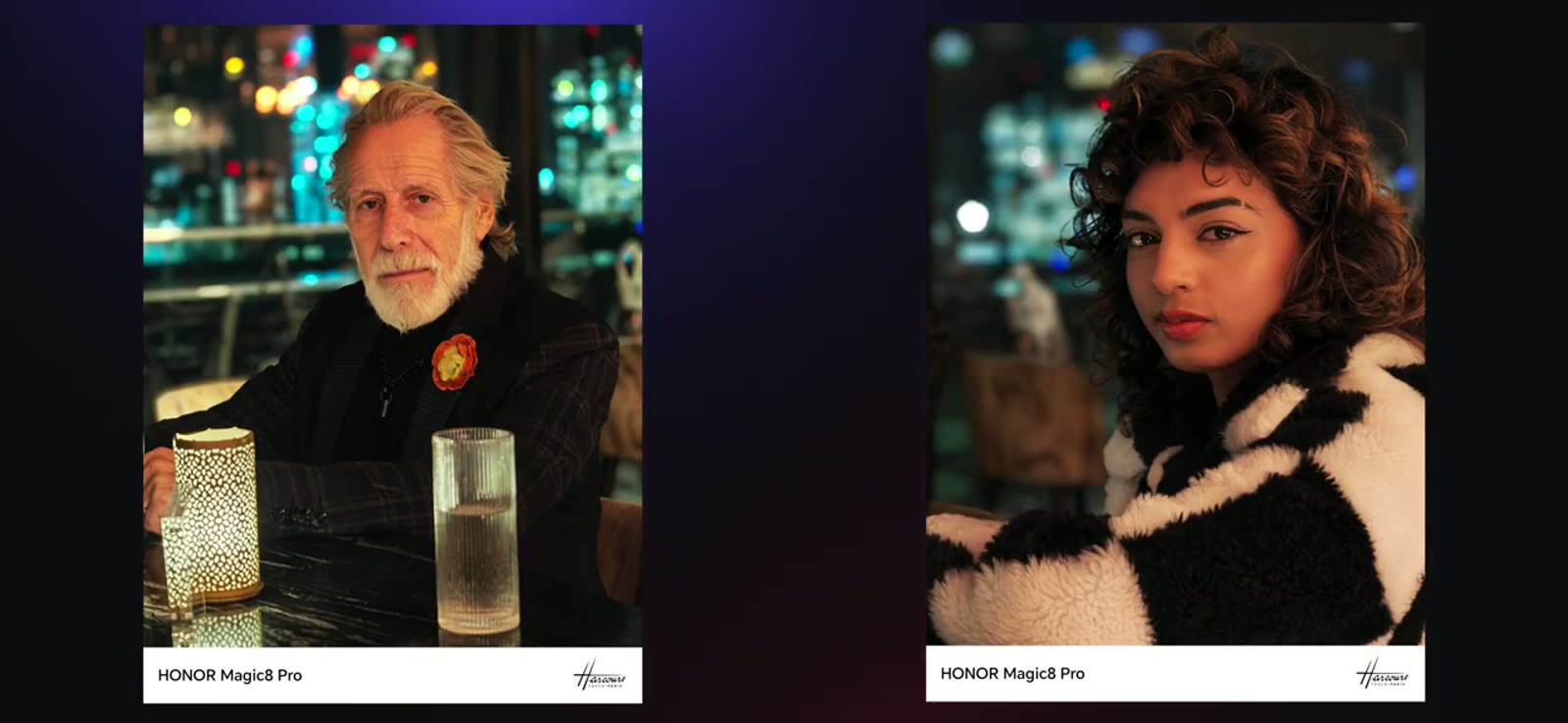
When you do want software portraits, this dimly lit London bar is about as tricky as it gets, and it’s cliché to say but these look like they came off a proper camera.
In old Cairo, at Khan el-Khalili, history isn’t written in books, it’s etched in silver and gold. A labyrinth of 14th-century stories where every corner is a photo opportunity, and I loved that the telephoto let me keep a respectful distance rather than intruding on people’s daily lives. The light there is horrible and beautiful at once: deep shadows under canopies, harsh sun, constant movement, cheap flickering artificial light. You don’t get a second chance at those shots. You can’t ask someone to rewind their life because your autofocus hunted.
Then Vegas, where I leaned on the zoom constantly and realised what makes it work: Honor rates its stabilisation at CIPA 5.5 stops, a professional camera standard, which lets it use a shutter speed roughly three times slower than rivals. I appreciate that Honor and Vivo use real photographic standards rather than fluffy marketing names.
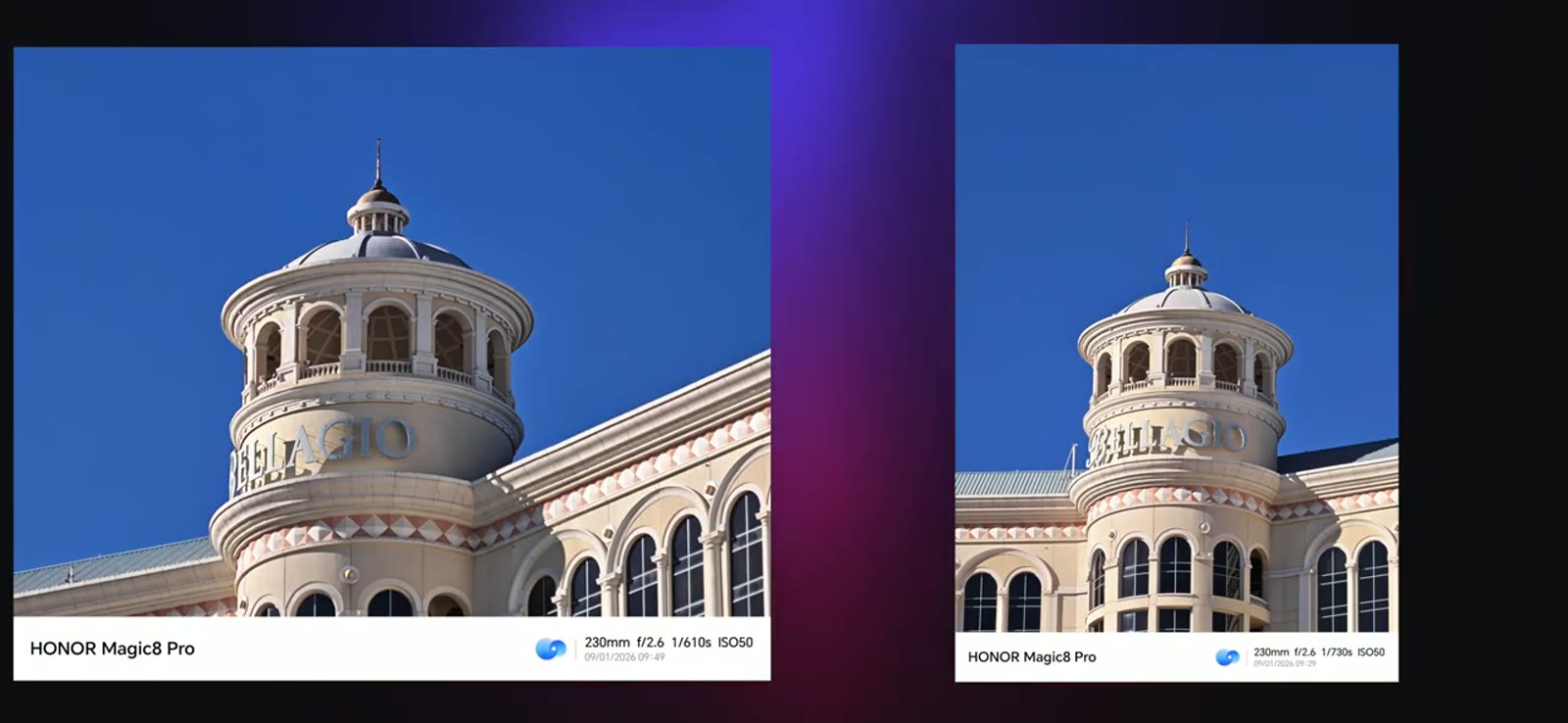
The proof is in the shots. At 10x the clarity on the Bellagio sign is nearly identical to the main lens, because it’s a near-lossless crop from the centre of that huge sensor rather than digital upscaling. And my favourite frame of the trip: shooting an aircraft fuselage at 85mm through a dirty terminal window at ISO 1250 and 1/50th of a second, handheld, while rushing for the gate. Normally that’s where smartphone zoom lenses fall apart. The reflection came out liquid smooth.
For fun I pushed the Stratosphere to 50x, then 100x, which is a 2,300mm equivalent at 1/80th of a second. That should be physically impossible and a blurry mess. There’s clearly AI at work by that point, but the fact the frame is readable at all is a testament to the stabilisation. It’s basically a tripod in your hand.
What I value beyond specs is fun, which some manufacturers forget entirely. Long exposure and panorama are both here, both enjoyable, and both would benefit from AI cleaning up the light-streak stutters. I’m nitpicking.
Software and the Light
Magic OS 10 (on Android 16) takes an already smooth experience and makes it more genuinely AI-integrated, predicting what you’re trying to do and surfacing the right app. Honor is becoming synonymous with AI features that aren’t gimmicks: removing reflections, deepfake detection, writing tools, the kind of thing that makes people say “wait, a phone does that?”
Worth a mention: the Magic 8 Light feels wrong to call mid-range. IP69K (that K means high-pressure, high-temperature water jets, so it survives a pressure washer, not just a dip), and a 7,500mAh silicon cell that gets a true three days, because without the periscope hardware there’s more internal volume for battery. I took an industrial stapler to it in the video, which tells you what I think of its durability.
The verdict
The Magic 8 Pro is a statement of technical prowess: raw Snapdragon 8 Elite Gen 5 power, second-generation silicon carbon, and eye-care display tech, all aimed at the actual limitations of using a phone all day. Eye strain, battery anxiety, hand strain. Together with the Light, this lineup is scary, not just for durability but for how far ahead of the competition it sits in 2026.
Samsung and Apple, over to you. And if you want to see exactly how it stacks up, the head-to-head with the S26 Ultra is on the site.